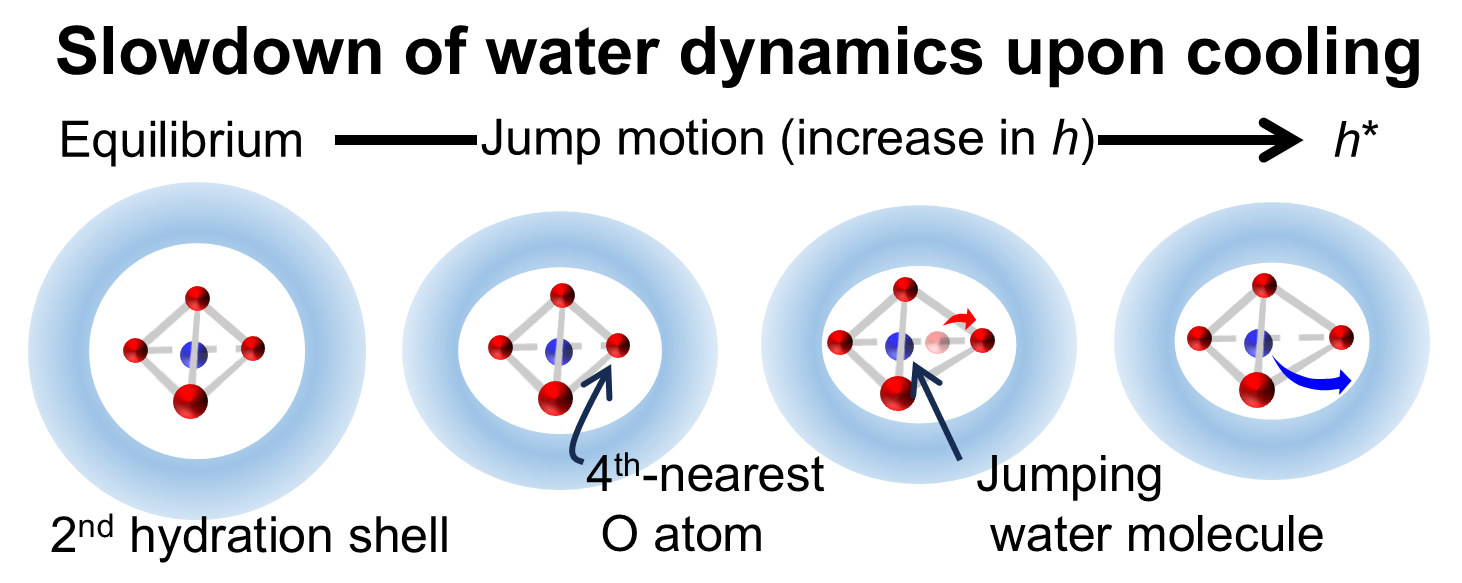
| Molecular mechanism underlying dynamic slowdown |
We have investigated molecular mechanism underlying dynamic slowdown based on dynamic disorder.
Dynamic Slowdown and Spatial Correlations in Viscous Silica Melt: Perspectives from Dynamic Disorder
The dynamic slowdown in glass-forming liquids remains a central topic in condensed matter science. Here, we report a theoretical investigation of the microscopic origin of the slowdown in amorphous silica, a prototypical strong glass former with a tetrahedral network structure. Using molecular dynamics simulations, we analyze atomic jump dynamics, the elementary structural change processes underlying relaxation. We find that the jump statistics deviate from Poisson behavior with decreasing temperature, reflecting the emergence of dynamic disorder in which slowly evolving variables modulate the jump motion. The slowdown is species-dependent: for silicon, the primary constraint arises from the fourth-nearest oxygen neighbor, while at lower temperatures, the fourth-nearest silicon also becomes relevant; for oxygen, the dominant influence comes from the second-nearest silicon neighbors. As the system is cooled, the jump dynamics become increasingly slow and intermittent, proceeding in a higher-dimensional space of multiple slow variables that reflect cooperative rearrangements of the network. Species-resolved point-to-set correlations further reveal that the spatial extent of cooperative relaxation grows differently for silicon and oxygen, directly linking their relaxation asymmetry to the extent of collective motion. Together, these results provide a microscopic framework linking dynamic disorder, species-dependent constraints, and cooperative correlations, offering deeper insight into the slowdown of strong glass-forming networks.
Kumar, Tang, & Saito, J.Chem.Phys. (2026).
Unraveling the dynamic slowdown in supercooled water: The role of dynamic disorder in jump motions
When a liquid is rapidly cooled below its melting point without inducing crystallization, its dynamics slow down significantly without noticeable structural changes. Elucidating the origin of this slowdown has been a long-standing challenge. Here, we report a theoretical investigation into the mechanism of the dynamic slowdown in supercooled water, a ubiquitous yet extraordinary substance characterized by various anomalous properties arising from local density fluctuations. Using molecular dynamics simulations, we found that the jump dynamics, which are elementary structural change processes, deviate from Poisson statistics with decreasing temperature. This deviation is attributed to slow variables competing with the jump motions, i.e., dynamic disorder. The present analysis of the dynamic disorder showed that the primary slow variable is the displacement of the fourth nearest oxygen atom of a jumping molecule, which occurs in an environment created by the fluctuations of molecules outside the first hydration shell. As the temperature decreases, the jump dynamics become slow and intermittent. These intermittent dynamics are attributed to the prolonged trapping of jumping molecules within extended and stable low-density domains. As the temperature continues to decrease, the number of slow variables increases due to the increased cooperative motions. Consequently, the jump dynamics proceed in a higher-dimensional space consisting of multiple slow variables, becoming slower and more intermittent. It is then conceivable that with further decreasing temperature, the slowing and intermittency of the jump dynamics intensify, eventually culminating in a glass transition.
Saito, J.Chem.Phys. (2024).