| Molecular mechanism underlying functional dynamics |
We have investigated molecular mechanism underlying functional dynamics based on dynamic disorder and ....
Beyond the Paddle-Wheel Mechanism: Hop Function Analysis of Ion Transport in Organic Ionic Plastic Crystals
The paddle-wheel mechanism has long been invoked to explain ion transport in organic ionic plastic crystals (OIPCs), wherein rotational motion of matrix ions is assumed to facilitate ion hopping. Here, we critically examine the paddle-wheel mechanism using molecular dynamics simulations combined with hop function analysis for a representative OIPC, Li-doped 1,3-dimethylimidazolium hexafluorophosphate ([MMIM][PF6]). While matrix ions ([MMIM]+ and PF6-) exhibit translation-rotation coupling consistent with the paddle-wheel mechanism, Li+ ion transport, central to the ion conductivity of solid state electrolytes, is decoupled from the rotational dynamics of neighbor ions. Instead, the hop function analysis reveals that the collective rearrangement of the 3rd, 4th and 5th nearest PF6- anions around Li+ forms the transition state configuration governing Li+ hopping. This process constitutes the primary Li+ ion transport mechanism, replacing the conventional paddle-wheel mechanism. Our results establish the hop function analysis as a robust framework for disentangling ion transport mechanisms in complex solid-state electrolytes and call for a reassessment of long-standing mechanistic assumptions in OIPCs.Park, Saito, Jang, & Sung, J.Amer.Chem.Soc. (2026).
Cascading Hopping as Ion Conduction Mechanism of Inorganic Glass Solid-State Electrolytes of Lithium-Aluminum-Chloride with Non-monotonic Composition Dependence
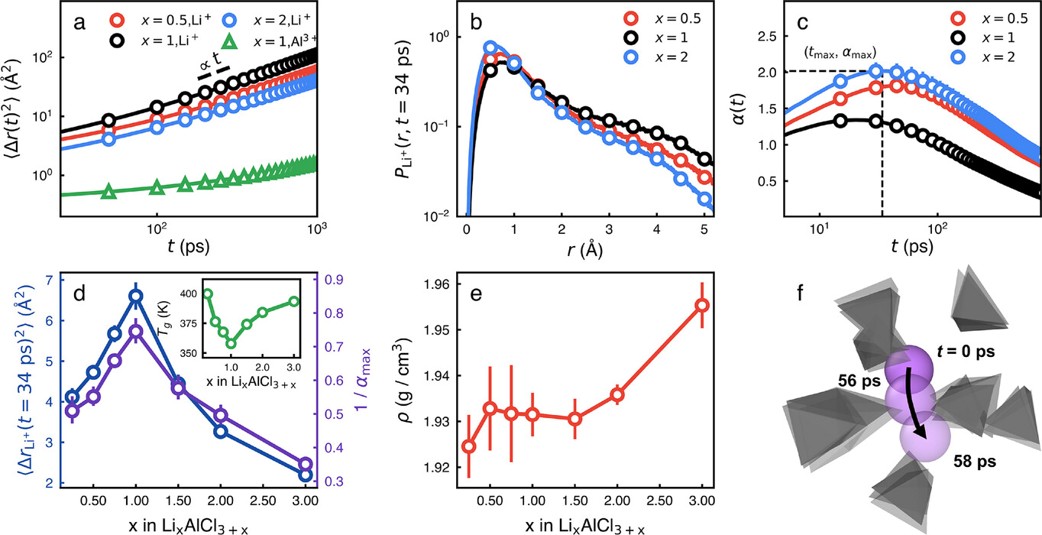
Inorganic glass solid-state electrolytes (IGSSEs) exhibit superionic conductivity at ambient temperature. Understanding their ion conduction mechanism remains challenging but is essential for the development of next-generation all-solid-state batteries. The coupling between lithium ion diusion and the rotation of neighboring polyanions, known as the paddlewheel eect, has been proposed as a possible mechanism, though its existence remains controversial. Herein, a systematic and extendible approach is proposed to explore the ion conduction mechanism of IGSSEs using large-scale machine learning molecular dynamics (MLMD) simulations and hop function analysis. A machine learning potential is constructed for model IGSSEs of Lix AlCl3+x (x = 0.25 to 3). MLMD simulation results reproduce the experimentally observed non-monotonic composition dependence of lithium-ion conductivity, with a maximum at x = 1. Hop function analysis reveals that lithium ion diusion occurs mainly via cascading hopping events rather than paddlewheel motions. The cascading hops are composition-dependent and account for the observed non-monotonic composition dependence. The non-monotonic composition dependence arises from a delicate balance between the local concentrations of lithium ions and the lithium vacancies.
Kang, Yu, Saito, Jang, & Sung, Adv.Sci. (2025).